Why Global Buyers Can't Trust Indian Suppliers Blindly — And What to Do About It
Why Global Buyers Can't Trust Indian Suppliers Blindly — And What to Do About It
Every year, importers across the UK, US, Europe, and the Middle East wire millions of pounds to Indian suppliers they have never physically met. Most transactions go smoothly. But a meaningful number do not — and the warning signs were almost always there, buried in public government records that nobody thought to check.
This article explains exactly what can go wrong, what data exists to protect you, and how to verify an Indian supplier before you place your next order.
The Real Risk of Buying From an Unverified Indian Supplier
The risk is not just fraud — though fraud does happen. The more common risk is subtler: a supplier that was legitimate when you first onboarded them quietly becomes problematic over time.
Here is what actually goes wrong:
GST registration lapses. A supplier stops filing returns. Their GSTIN becomes inactive. You are still placing orders with them, invoicing through a GSTIN that is no longer valid. Your input tax credit claims become invalid. You may face compliance problems in your own country.
Company gets struck off. The Ministry of Corporate Affairs strikes off thousands of companies every year for non-compliance. If your supplier's company is struck off, they can no longer legally operate — but they may continue taking orders anyway.
Directors change without notice. The person you did due diligence on three years ago is no longer a director. New directors with a history of failed or defaulting companies have come on board. You have no idea this happened.
Court cases are filed. A supplier may face civil or criminal proceedings — debt recovery cases, cheque bouncing cases, commercial disputes. These are all public records. But nobody is telling you.
Export license expires. Indian exporters are required to hold a valid IEC (Import Export Code) issued by the DGFT. If that lapses, they are not legally permitted to export. Orders placed after that point can face serious customs complications.
None of these events are hidden. All of them are recorded in publicly accessible Indian government databases. The problem is that checking them manually requires navigating six different portals, understanding Indian regulatory terminology, and doing it repeatedly over time — because things change.
What Data Actually Exists on Indian Suppliers
India has surprisingly strong public disclosure infrastructure for business compliance. Here is what is available and where it lives:
GST Portal — Every business registered for GST in India has a 15-digit GSTIN. The GST portal shows registration status (active, cancelled, suspended), business type, registered address, and return filing frequency. A supplier who has not filed returns in the last three months is already showing a compliance warning signal.
MCA21 (Ministry of Corporate Affairs) — For private limited companies, LLPs, and public companies, MCA21 holds company registration date, paid-up capital, current status (active, struck off, under liquidation), and full director details including DIN numbers and linked companies. A director linked to three previously struck-off companies is a meaningful risk signal.
DGFT (Directorate General of Foreign Trade) — The IEC database confirms whether a supplier holds a valid export licence and when it was granted. Any supplier claiming to be an exporter without a valid IEC is operating outside the law.
eCourts — The National Judicial Data Grid holds records of ongoing and concluded court cases across district and high courts. Cases filed against a company or its directors are searchable.
EPFO (Employees' Provident Fund Organization) — Provident fund compliance is a proxy for actual workforce size. A supplier claiming 500 employees but registered for EPFO contributions for 12 people is flagging an inconsistency worth investigating.
The problem is not a lack of data. The problem is that checking all of this manually, for every supplier, every month, is simply not practical for a small or medium-sized importer.
How IndiaTradeCheck Solves This
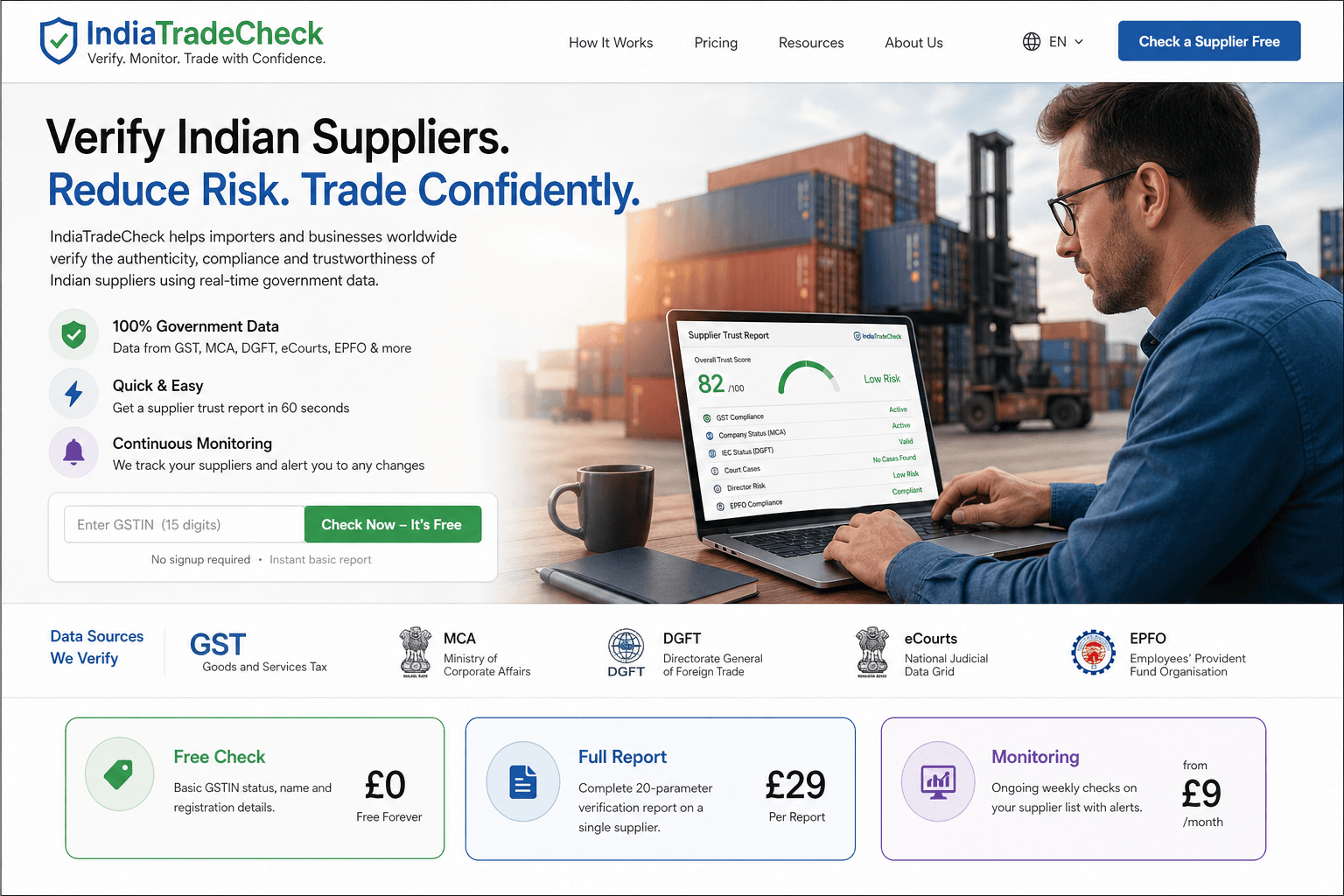
IndiaTradeCheck aggregates all of this public data into a single supplier trust profile. You enter a GSTIN. We return a structured verification report covering GST status, MCA21 company record, IEC export licence, court case history, director risk signals, and a plain-English trust score from 0 to 100.
For buyers who work with Indian suppliers regularly, our monitoring product automatically tracks your suppliers week to week and alerts you the moment something changes — a missed GST filing, a status change, a new court case, a director departure.
Free check — Basic GSTIN status, name, and registration details. No signup needed.
Full report — £29 — Complete 20-parameter verification report on a single supplier.
Monitoring — from £9/month — Ongoing weekly checks on your supplier list, with email and WhatsApp alerts.
A Practical Due Diligence Checklist Before You Place an Order
Even before you use a platform like ours, here is a minimum viable checklist any importer should run through:
Verify the GSTIN is valid and active — Do not accept an invoice with an inactive or unregistered GSTIN. Your tax compliance depends on it.
Check business type — Is this a Private Limited company, a proprietorship, or a partnership? The legal accountability and traceability are very different.
Check company age — How long has this company been registered? A business registered three weeks before they emailed you cold deserves scrutiny.
Verify the IEC — If they claim to be an exporter, they must have a valid IEC. Ask for it and confirm on the DGFT portal.
Search the director names — Look up the directors on MCA21. Are they linked to other active companies? Any struck-off entities in their history?
Check GST return filing — Sporadic or lapsed GST return filing is a compliance risk for you and a business health signal about them.
Set a reminder to recheck in six months — Due diligence done once and never repeated is not due diligence. It is a snapshot that goes stale.
The Bottom Line
India is the world's fifth-largest economy and one of the most important global sourcing destinations across textiles, pharmaceuticals, engineering goods, chemicals, food products, IT services, and more. The scale of trade is enormous. The infrastructure for buyer-side trust verification has not kept pace.
That is what IndiaTradeCheck is building. A simple, affordable, self-serve trust layer for anyone doing business with Indian suppliers — whether you are placing your first order or managing a portfolio of fifty active supplier relationships.
The data is public. The risk is real. The check takes sixty seconds.